A symbolic AI system developed by historian András Nyírő between 1991 and 1993
friendly hostile neutral Click an edge to change it; right-click to clear. Click an actor for strategies.
Core balance and cycle logic follows the recovered help. The example BEFORE/AFTER graph states are recovered directly from the original executable. The interactive strategy engine in this browser reconstruction remains a functional reconstruction.
Turbo Simmel 2.1 — Symbolic AI for Social Network Analysis
Turbo Simmel is a symbolic AI system that combines signed graph analysis, structural balance, sociological theory and a small expert knowledge base to analyse social conflicts, alliances and coalitions.
How it works
The program represents a social situation as a signed graph. Actors are nodes; positive relationships are +1 edges, negative relationships are −1 edges, and 0 means that no relevant relationship has been defined. The graph is the internal model on which the system reasons.
The system searches the network for elementary cycles, examines the pattern of positive and negative edges and calculates structural balance. A cycle is balanced when the product of its edge signs is positive, and unbalanced when it is negative.
It then maps graph patterns to social situations and evaluates the position of a selected actor. The reasoning chain is:
graph → elementary cycles → structural balance → social pattern → actor position → expert rule → strategy
The theoretical model
Georg Simmel analysed the social structures created by a third actor, including mediation, tertius gaudens and divide et impera (Simmel, 1950 [1908]). Theodore Caplow analysed how power relations influence coalition formation in groups of three (Caplow, 1956). Structural balance theory formalised positive and negative social relationships as signed graphs (Cartwright & Harary, 1956).
The expert knowledge base
The graph-analysis engine is combined with a small expert knowledge base. Its examples are drawn from Georg Simmel's analysis of the triad. They provide concrete cases for the social configurations and strategies encoded in the system.
The knowledge base contains recognised social configurations, coalition patterns, structural-balance conditions, actor positions and strategy rules. The surviving executable contains more than twenty named strategies, including Friend Mediates, Tertius Gaudens, Builds a Coalition, Provokes a Conflict, Divide, Joins Against Common Enemy, Enemy's Friend = Enemy and Enemy's Enemy = Friend.
The system compares the current graph with patterns in the knowledge base and determines which strategies apply from the position of the selected actor. This is rule-based inference over a graph representation.
From analysis to strategy
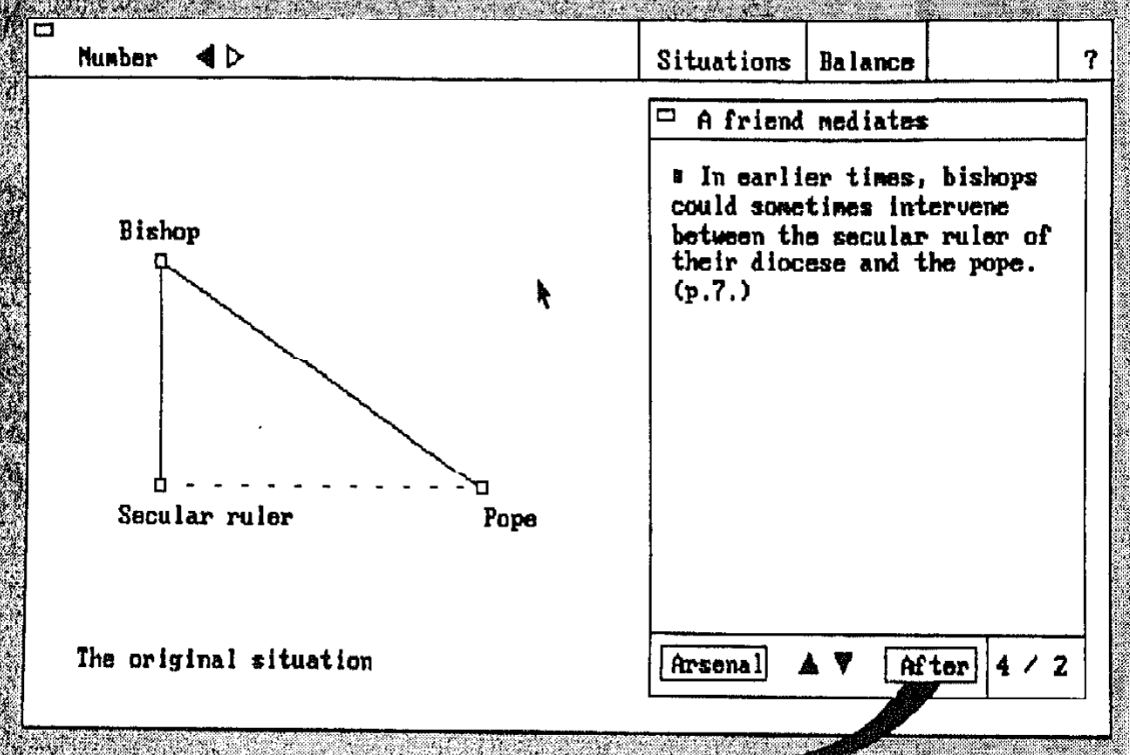
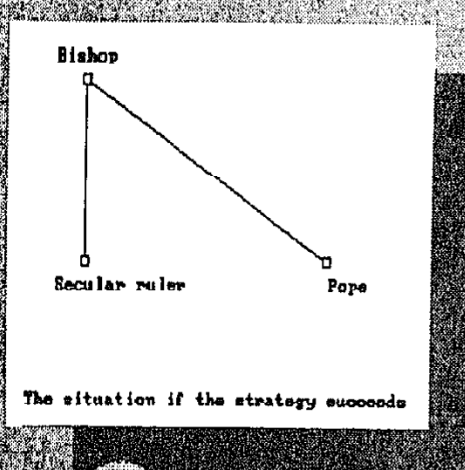
A strategy represents a possible change in one or more relationships. The program can display the network that would result if the strategy succeeds, and the new graph can then be analysed again. The History function stores successive network states, making it possible to explore alternative social dynamics.
Symbolic AI
Turbo Simmel represents knowledge explicitly as actors, relationships, graph structures, sociological categories, rules and strategies. It combines graph analysis, knowledge representation, pattern recognition, rule-based inference, decision support and simulation.
Reconstruction
The original source code has been lost. The compiled DOS program survived together with its help file, installation files and example library. In 2026, I reconstructed the system with the help of ChatGPT: the surviving executable and data files were analysed, the original help and examples were recovered, and the graph-analysis and expert-system logic were documented. The browser version is a functional reconstruction rather than a line-by-line recovery of the lost source code.
Original 1993 interface
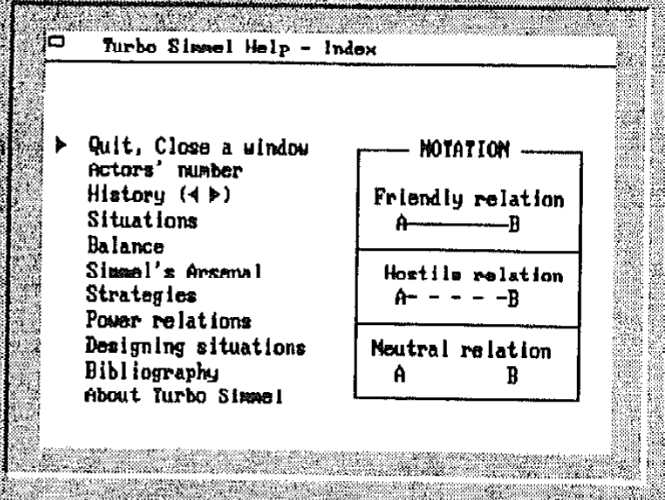
These screenshots come from the original one-page Turbo Simmel flyer and show the DOS interface, the strategy outcome view and the built-in help system.
Original situation: the Bishop mediation example.The situation if the strategy succeeds.The original Turbo Simmel Help index and relationship notation.
Contemporary publication: András Nyírő, “Simmel találkozik a multimédiával,” Replika 9–10 (1993), pp. 60–61. The same issue also carried a Turbo Simmel advertisement on pp. 58–60.
References
Caplow, T. (1956). A theory of coalitions in the triad. American Sociological Review, 21(4), 489–493.
Cartwright, D., & Harary, F. (1956). Structural balance: A generalization of Heider's theory. Psychological Review, 63(5), 277–293.
Simmel, G. (1950 [1908]). The triad. In K. H. Wolff (Ed. & Trans.), The Sociology of Georg Simmel (pp. 145–169). Glencoe, IL: The Free Press.